
Lecture 13 · First Test Review
Review part one: elimination, four subspaces and the main line of rank.
On this page
Quiz 1 review | Gilbert Strang | MIT 18.06 Linear Algebra
Lecture 13 / Total 35 Lectures |Part 2 · Orthogonality and Determinant
Video of this lecture: Bilibili p13 · First test review ↗(47:40)| MIT OCW official page ↗
Illustration: MIT OCW 18.06SC official lecture summary (CC BY-NC-SA 4.0) and Bilibili classroom video frames (time stamped), about 10 frames per lecture.
Introduction to this lecture
Review the first part of this lecture, that is, This main line: elimination, rank, vector space and subspace, and by The four fundamental subspaces generated. The focus of the review is on the rectangular matrix. When the square matrix is reversible, there are many things that you don’t need to think about in detail - the homogeneous equation has only zero solutions, and there is a unique solution for each right-hand side; once the matrix becomes a rectangle, these conclusions are no longer automatically true. Which ones are still true and which ones are not true are exactly what the test asks.
The way to review is to use old test questions instead of rereading the definitions. The questions often only give part of the information: a general solution, the shape of a block matrix, a sentence about subspace, and require you to turn the definition over and deduce the matrix itself or the dimension of a certain space. This type of questions seems to be diverse, but the answers all fall on the same table: as long as you get , , With three numbers, the dimensions of the four basic subspaces are all determined.
This lecture classifies the test points into five categories: dimensional accounting, inverse matrices from general solutions, true and false judgments of four basic subspaces, product matrices with reversible factors, and why row space and null space only intersect at the zero vector. The last question already points to the orthogonal nature of the next lecture.
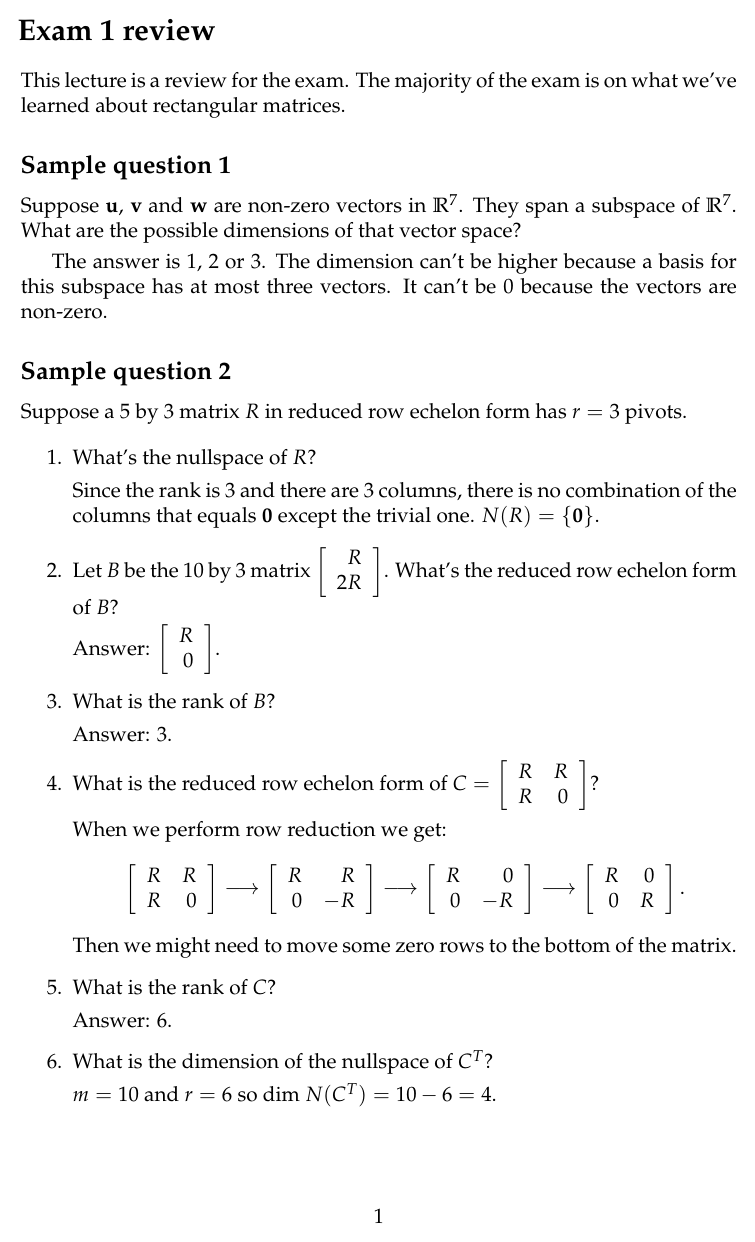
MIT OCW Official Lecture Notes Summary Page 1/5 (18.06SC Lecture 13 Summary, CC BY-NC-SA 4.0).
1. Test point 1: use Count four dimensions at once
Set is matrix, rank . Which space the four basic subspaces live in and what their dimensions are are completely determined by these three numbers:
| subspace | space | dimension |
|---|---|---|
| column space | ||
| nullspace | ||
| row space | ||
| left nullspace |
The first step in solving dimensionality problems is always to find and : See how many rows and columns the matrix has. In the second step, count the pivot (pivot) to get . The order of these two steps cannot be reversed because which number should be used to subtract? , depends on how many dimensions the vector in this null space has. The entire process can be fixed into four steps: reading the shape, determining , Number of main elements are obtained , find out the four dimensions according to the table; if any step in the middle is omitted, the answer may be misaligned as a whole.
Example 1. is There are three non-zero vectors in the vector. How many dimensions may the subspace spanned by them have?
The answer is 1, 2, 3. It will not exceed 3. The span is generated by three vectors, with up to three independent directions; it cannot be 0, because every vector is non-zero, and the span contains at least one non-zero vector. If all three vectors are allowed to take zero vectors, then the subspace with dimension 0 It must also be included - the “non-zero” condition plays this role in the question.
Example 2. is is a ladder-shaped matrix with three pivot elements, . What is it?
There are only zero vectors. The reason should be said in terms of dimensions, not “because it is a ladder shape”: , , so . The three columns are all pivot columns and there are no free variables. There is only zero solution.
Example 3. put two Stack it up , it is . What are the rank, simplest form and null space of ?
You can see it clearly by eliminating elements: the lower half minus twice the upper half, form , the rank is still 3, and the null space is still - Repeating the same line does not lead to new directions. To get it all the way to the row reduced echelon form, just normalize the pivots to 1 and clear the elements above the pivots to zero; the zero row is already at the bottom.
Example 4. Made of four blocks , it is . What is the rank of ? What are the dimensions of ?
Still doing block elimination. Subtract the upper half of the five elements from the lower half of the five elements, and we get ; Then eliminate the second piece of the upper half with the lower half, that is, add the upper half to the lower half, and we get
two Each has three main elements and does not interfere with each other, so .
Note the difference from Example 3: The two zero rows of the matrix fall into the middle of the matrix after splicing. When converting the rows into their simplest form, they should be sunk to the bottom and then normalized by the pivot element.
thus
The most common mistake here is which number to subtract in the last step: is , the vector in its null space belongs to , so take To subtract; if you use column numbers conveniently If you subtract, you will get the wrong answer of 0. In the same question, two zero spaces must also be distinguished: The number of columns is 6 and the rank is 6, so Only the zero vector remains, and It is four-dimensional, and the two are not the same thing.
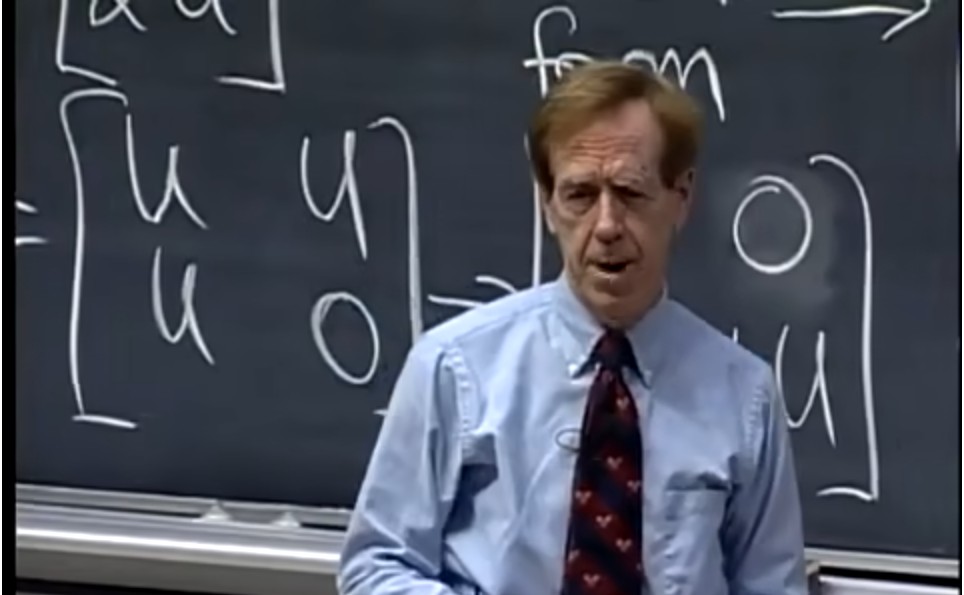
Video 00:11:37|Approximately corresponding to Section 1 “1. Test Point 1: Use “Count four dimensions at once”.
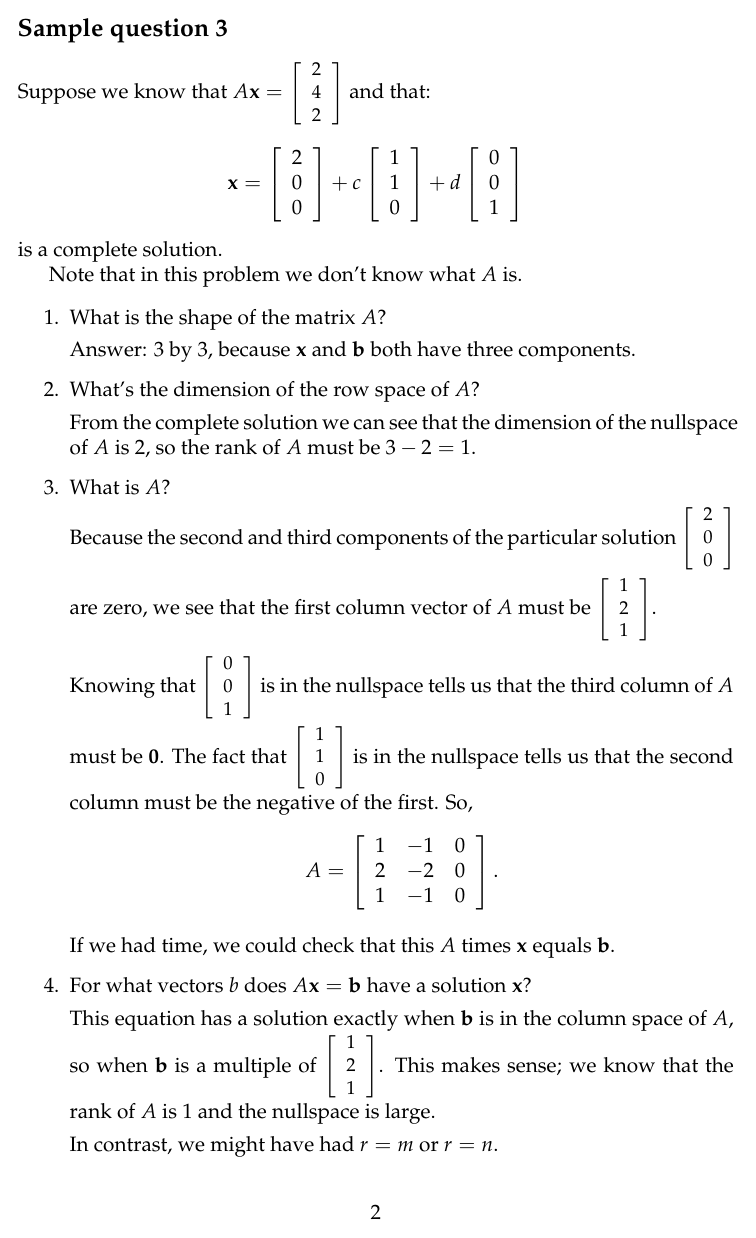
MIT OCW Official Lecture Notes Summary Page 2/5 (18.06SC Lecture 13 Summary, CC BY-NC-SA 4.0).
2. Test point 2: Reverse the matrix from a general solution
The second type of questions is asked backwards: no matrix is given, only an equation and its general solution are given, and you are asked to find the matrix.
Set The right end of is , the general interpretation is
Ask for The row space dimension of itself. The method is to translate each piece of the general explanation into of a message.
The first step is to determine a column for the particular solution. order , the special solution is . multiply by Only the first component plays a role, so equal to twice the first column; it should be equal to , divide both sides by 2, the first column is .
The second step is to count the free variables to get the rank. There are two arbitrary constants in the general solution, indicating that ; is three-dimensional, so , so
The dimension of the row space is equal to rank, so the answer is 1.
The third step is to translate the basis vectors of the null space into column-to-column relationships one by one. In null space, explain The third column is allowed to cancel when multiplied by a factor of 1, i.e. the third column is a zero vector. In the null space, it means that the first column plus the second column is zero, and the second column is equal to . So
Test: The first and third rows are the same, the second row is twice the first row, the rank is indeed 1; the column space is multiples of all. Ask again “for which ones?” The equation is solvable”, the answer is all multiples. Given by the question Exactly qualified; because , the column space is just A straight line in , most of them None of them are in the column space.
The approach to this type of problem can be memorized into three sentences: the specific solution determines the sequence, the free variable determines the rank, and the basis vectors in the null space determine the sequence relationship. On the other hand, if you are given a general solution to a matrix, you need to eliminate elements, find the pivot column, take turns taking 1 for the free variables, and write out the special solution and add the null space.
The error-prone point is to read the zero-space vector as a row relationship. It says “the third column is all zeros”, not “the third row is all zeros”; It is said that the sum of columns and columns is zero. The null space vector is The coefficient of each column, its corresponding object is always the column.
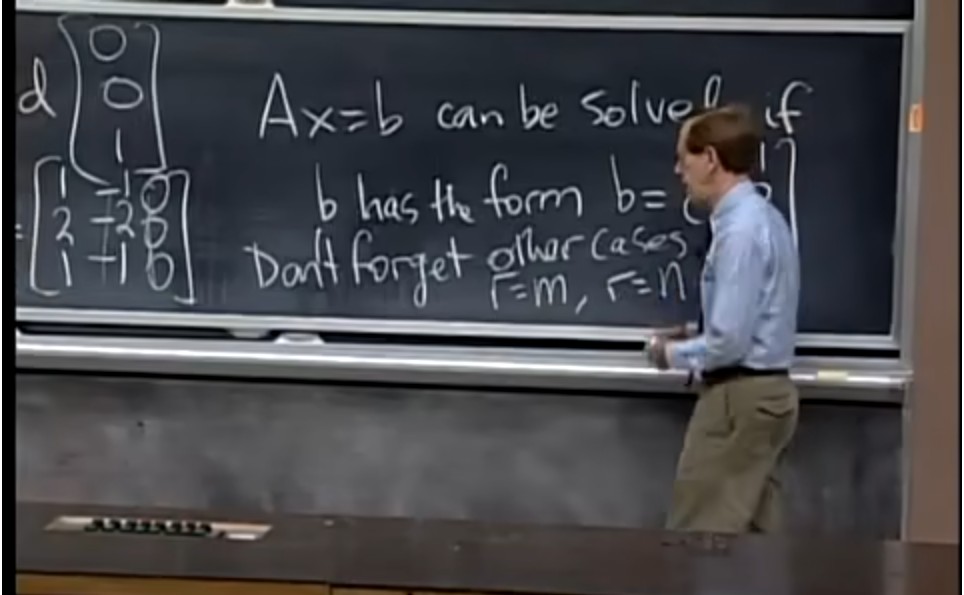
Video 00:18:07 | Approximately corresponding to Section 2 “2. Test Point 2: Reverse the Matrix from a General Solution”.
3. Test point 3: Quick judgment of four basic subspaces
A large part of the review class is this kind of one-sentence true-false questions, which are quick to answer and also test the familiarity with definitions. The following are the propositions reviewed in this lecture.
There is a time-saving order for doing true and false questions: if you want to assert “false”, you only need to cite a counterexample; if you want to assert “true”, you must give a reason that is true for all matrices. Citing a few examples does not count as proof. When you get stuck, try the extreme case first - make the matrix reversible, zero matrix, or rank 1 matrix. You can often tell at a glance which type of matrix the proposition fails.
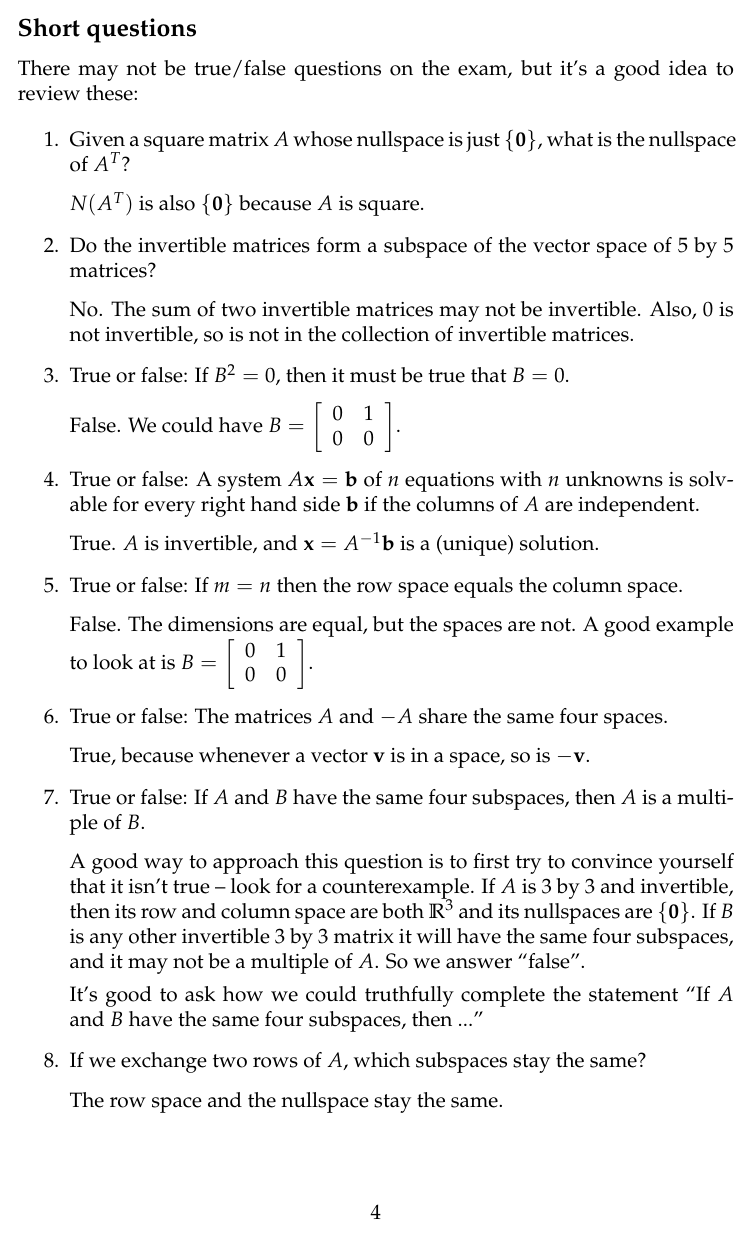
The null space of the square matrix and the null space of the transpose. If It is a square matrix and , then . real. square formation , given , so .
Invertible matrices do not form subspaces. All The matrix is a 25-dimensional vector space, in which the invertible matrix is No subspace. The most direct reason: the zero matrix does not belong to it, and the subspace must contain zero vectors. The universe of singular matrices is also not a subspace - the sum of two singular matrices is entirely possible to be invertible, e.g. .
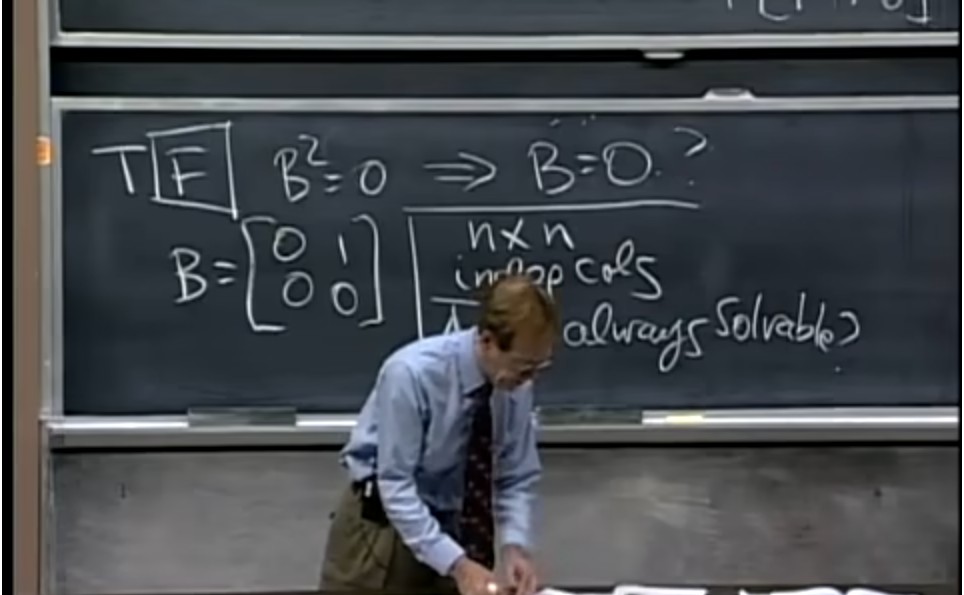
Whether to launch ? False. The counterexample is
This matrix will appear again and again later in the course as an “example of what went wrong.”
equation unknowns and column vectors are linearly independent, whether for each Can all be solved? True. Column independent , reversible, to any There are solutions. This is a “good situation” when a square matrix is reversible, but don’t regard it as the only situation. The rectangular matrix is the focus of the review.
When row space equals column space? False. take , the row space is is a multiple of , the column space is Multiples of , two different straight lines. A symmetric matrix will definitely make the two coincide - the rows and columns are the same batch of vectors after transposition.
with Have the same four subspaces? True. The overall sign change does not change any Zhang Cheng, with Same explanation.
If There are the same four subspaces, whether it is Multiples of? False. Take any two Invertible matrix, the four subspaces are , exactly the same, but there is generally no multiple relationship between the two invertible matrices. The only thing that can be deduced is “the same rank”; the four subspaces record the direction, not the role of the matrix in the direction.
Exchange Which subspaces are unchanged in the two rows? The row space and null space remain unchanged, but the column space generally changes. The two rows are a set of generated vectors in the row space. Changing the order does not change the span; exchanging the order of the equations does not change the solution set. Column spaces are different: The column space is A multiple of , after line breaks, it becomes multiples.
Finally, remember the two extremes of full rank, which are the general outlines of true-false questions. (The line is full of rank, ) when the column space is the entire , each can be solved, but generally not unique, because . (Full rank, ), the null space has only zero vectors, and the solution is unique if it exists, but not every All in column space.
MIT OCW Official Lecture Notes Summary Page 3/5 (18.06SC Lecture 13 Summary, CC BY-NC-SA 4.0).
Video 00:25:26 | Approximately corresponding to Section 3 “3. Test Point 3: Rapid Judgment of Four Basic Subspaces”.
Video 00:30:59 | Approximately corresponding to Section 3 “3. Test Point 3: Rapid Judgment of Four Basic Subspaces”.
4. Test Point 4: For products with reversible factors, first read the structure before writing.
There is a type of question where a matrix is written as the product of two matrices. Direct multiplication is time-consuming and easy to make mistakes; the correct approach is to first see the structure clearly.
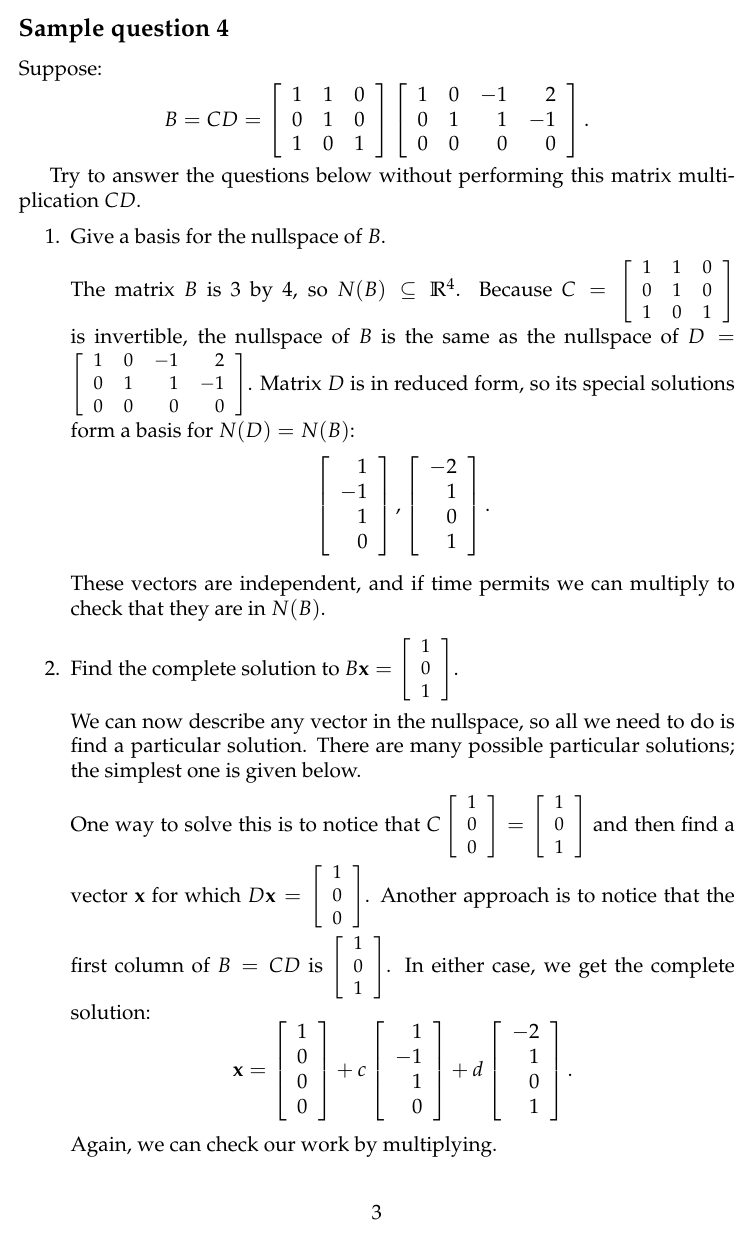
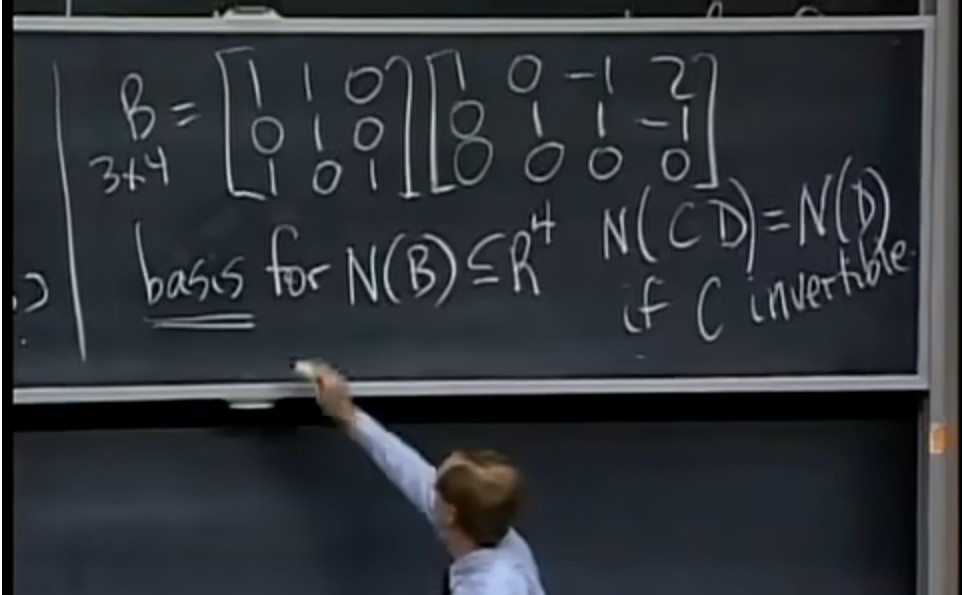
Set , among which
is , is , so is , to find the null space, we need to find vector in .
Look first . Its three columns are , , . The second column has a 1 in the second component, and the other two columns have a 0 in that position, so any combination equal to zero must first force the coefficient of the second column to 0; the remaining two columns are obviously irrelevant. Therefore Reversible.
Key takeaways: Reversible . On the one hand, Take left on both sides Got ;On the other hand, Take left on both sides Got . Invertible matrix left multiplication will not compress non-zero vectors to zero, and it will not change the null space. The same reason is given .
So just solve . The pivot columns of are columns 1 and 2, and the free variables are ;Write the previous two lines into chunked form (The third line is all zeros), where
The two columns are the two basis vectors of the null space: given , given . Substitute verification: The first line of is , the second line is . Note that the upper block of the null space matrix is instead of : The main variable is equal to “negative Multiplying free variables”, with the sign reversed, is the most common mistake here.
Another question: Solution . No need to multiply out . The first column of is multiply the first column of , that is the first column of , exactly equal to the right end, so the special solution is That’s it, the general interpretation is
The special solution is not unique. Any solution that satisfies the equation can serve as a special solution, and the one with the least effort is chosen. The structure of “general solution = a special solution + null space” does not depend on the size of the matrix or the finite dimension of the system of equations. It is a general pattern of linear systems.
MIT OCW Official Lecture Notes Summary Page 4/5 (18.06SC Lecture 13 Summary, CC BY-NC-SA 4.0).
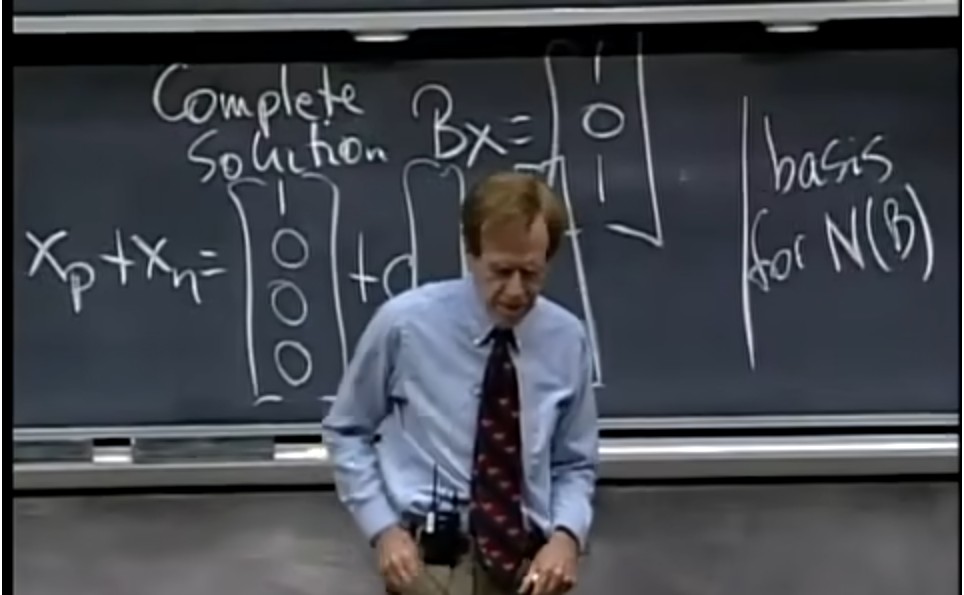
Video 00:36:48 | Approximately corresponding to Section 4 “4. Test Point 4: Products with reversible factors, first look at the structure before writing”.
5. Test point 5: Why do row spaces and null spaces have no common non-zero vectors?
The last question is forward-looking. vector Can it be both A certain line of , and it falls in Where?
No. Suppose the first line is , and , then ; but The first component of is Dot product with itself:
Contradiction, it can be seen that such a matrix cannot be assembled: the rest of the matrix is filled in casually, and the conflict only occurs in this row.
The conclusion is: both row space and zero space live in , but only intersect at the zero vector. Putting the two pieces of information together: the line space is dimension, the null space is dimensional, both Within, the dimensions exactly add up to , the intersection has only zero vectors - this is the dimensional precursor of the orthogonal complement. Going one step further, the null space and the row space are perpendicular to each other. The next lecture will start from here to talk about orthogonality and orthogonal complement.
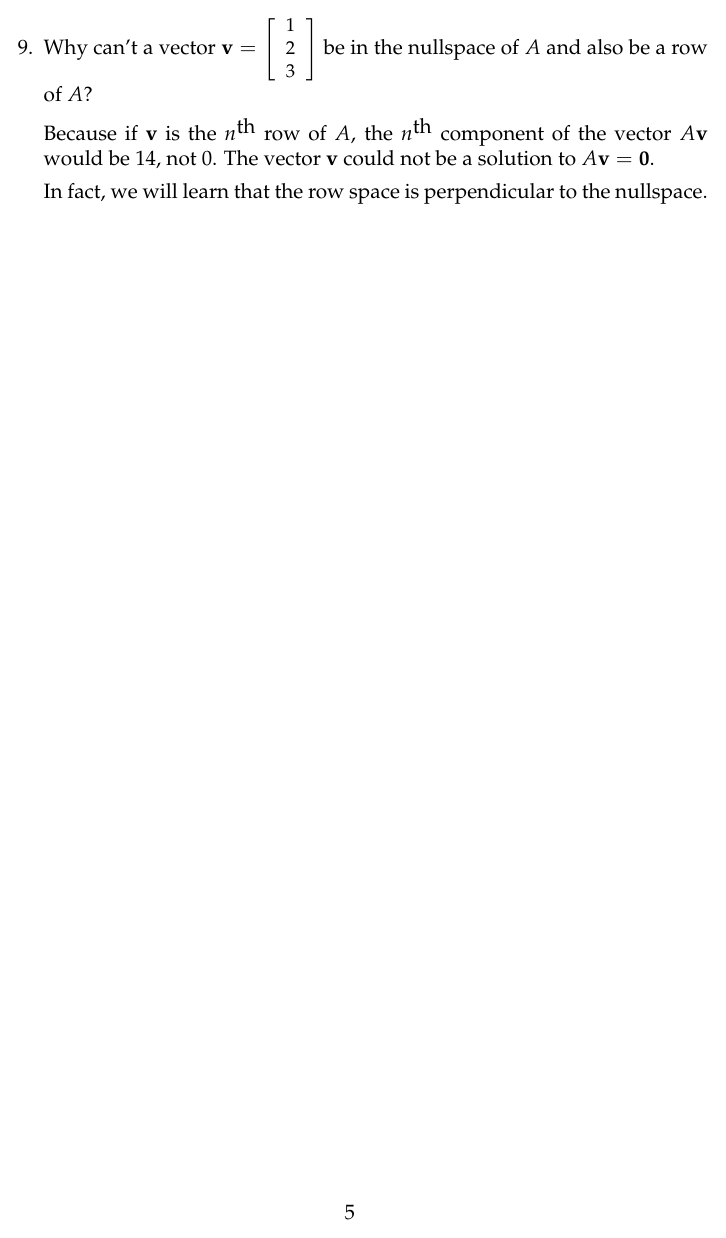
MIT OCW Official Lecture Notes Summary Page 5/5 (18.06SC Lecture 13 Summary, CC BY-NC-SA 4.0).
Summary of this lecture
- The dimensions of the four basic subspaces are only given by Decision: Column space vs. row space is dimension, the null space is dimension, the left null space is dimension; solve the problem first , then count the main element to get .
- The subspace formed by three non-zero vectors in may be 1, 2, or 3 dimensions; the upper bound comes from “only three vectors”, and the exclusion of 0 dimensions comes from “non-zero”.
- If the matrix has three pivot elements, the null space only has zero vectors; put two such Stacked into of , the rank is still 3, and the zero row is already at the bottom.
- block matrix is , the block is digested into , the rank is 6, so .
- There are three clues to infer the matrix from the general solution: the specific solution determines a certain column, the number of free variables determines the rank, and the basis vectors in the null space give the relationship between columns; in this example, we get , , the solvable right-hand side is multiples.
- Key points of the true-false question: If the null space of a square matrix is trivial, then the transposed null space is also trivial; neither the reversible matrix nor the singular matrix constitutes a subspace; Not launched ; Row space is generally not equal to column space.
- The same four subspaces can only deduce the same rank, but cannot deduce that the matrix is proportional; two An invertible matrix is a counterexample.
- Swap two rows to maintain the row space and null space, but the column space will change; there are two extremes of full rank with Determines solvability and uniqueness.
- Reversible , , so the null space of the product does not need to be multiplied; The first two lines of are written as , the null space basis is , the sign should be reversed.
- The intersection of row space and null space has only zero vectors: if If it is a row and a zero-space vector at the same time, then there must be equal to , a contradiction; the next lecture proves that these two spaces are orthogonal.
keywords
| English | Chinese | One sentence explanation |
|---|---|---|
| rank | rank | The number of pivots is also the dimension of column space and row space. |
| column space | column space | All linear combinations of columns fall within |
| nullspace | null space | satisfy of all , falls on |
| row space | row space | All linear combinations of rows, colocated with null space |
| left nullspace | left null space | satisfy of , falls on |
| dimension | dimension | The number of basis vectors in the space |
| basis | base | A set of vectors that span the entire space and are linearly independent |
| span | Zhang Cheng | A subspace composed of all linear combinations of a set of vectors |
| linearly independent | linearly independent | Only all zero coefficients can combine to create a zero vector |
| free variable | free variable | The variable corresponding to the non-pivot column can be any |
| particular solution | special solution | satisfy a solution of |
| general solution | General explanation | Special solution plus any vector in null space |
| row reduced echelon form | row simplest form | A ladder shape with the pivot element being 1, the remaining elements in the pivot column being zero, and the zero row sinking to the bottom |
| full rank | full rank | or , solvability and uniqueness are respectively determined by the dimension on the other side |
| subspace | subspace | A set of vectors that are closed to addition and multiplication and contain zero vectors |
Machine-assisted translation · Read Chinese original